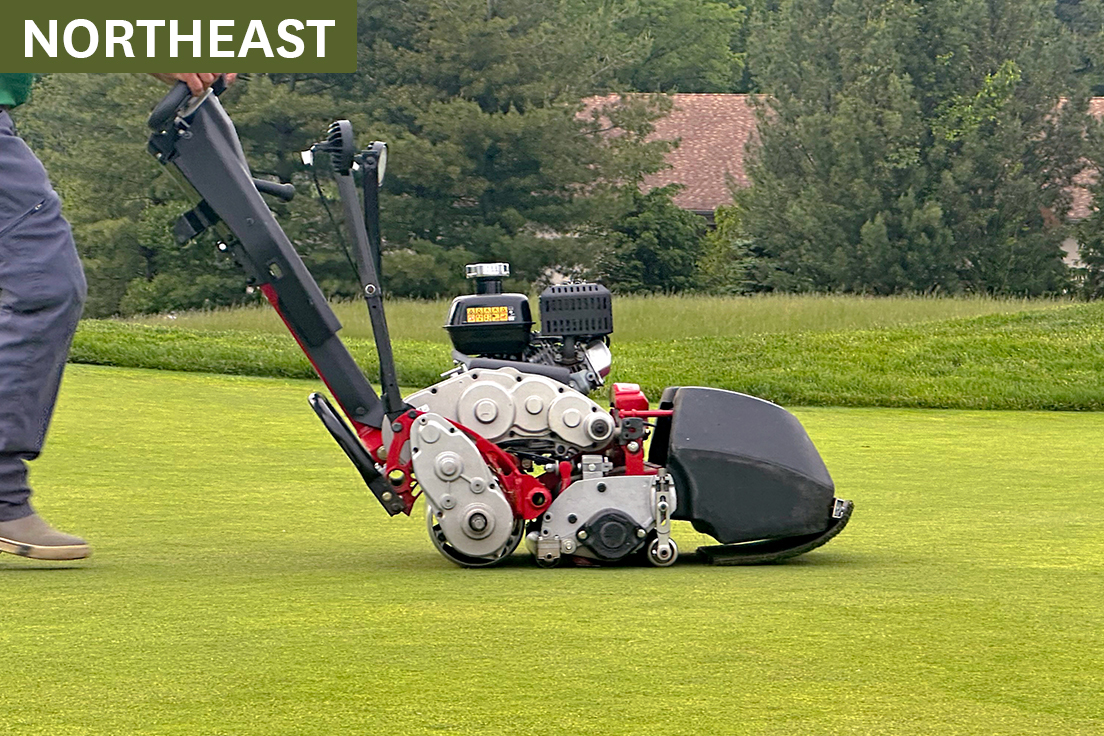
Attaching synthetic mats to mower baskets is an easy way to gently brush putting surfaces ahead of the mower blades.
Brushing is a simple yet highly effective practice for improving the texture and consistency of fine turf surfaces without creating significant stress or disruption. Light to moderate brushing helps stand turf leaves upright before mowing, which improves cutting quality and encourages a more uniform and upright growth habit. This can be particularly valuable on putting greens containing a mixture of creeping bentgrass and annual bluegrass, where differences in growth habit and leaf texture can contribute to an inconsistent surface.
Several brushing techniques can work well. Synthetic grooming mats can be attached to mower baskets and dragged across the turf ahead of mowing, while fold-down brushes mounted on cutting units provide a consistent, light brushing action immediately ahead of the reel. Rotating brushes offer another option and can provide slightly more active grooming when needed. Regardless of the method, the objective should be to manipulate the turf canopy rather than aggressively penetrate or disturb it. Keep in mind that brushing too aggressively or when putting greens are under stress can negatively affect turf quality, so frequency and aggressiveness should be adjusted based on turf conditions, weather and desired playing characteristics.
One of the greatest advantages of brushing is its ability to refine surface texture without dramatically affecting green speed. By standing leaves upright and presenting more of the plant to the cutting unit, brushing can reduce lateral growth and improve mowing quality to create a tighter, more consistent surface. On mixed bentgrass and annual bluegrass putting surfaces, this can help blend the two species visually and functionally while producing smooth and true ball roll.
Brushing also provides an excellent alternative when more aggressive mechanical practices are unnecessary. Unlike vertical mowing, which can have visual and playability impacts that take time to heal, light brushing can often be incorporated into routine mowing with very little disruption to playability. It doesn’t need to be done every day, but when used consistently and appropriately, brushing becomes less of a corrective treatment and more of a turf-training technique that gradually encourages upright growth, improves texture, and maintains high-quality playing surfaces with minimal disruption.
USGA Green Section contacts: Darin Bevard, senior director, Championship Agronomy; Elliott L. Dowling, regional director, East Region; Brian Gietka, agronomist.
Read the full article at USGA.org.